

Hierarchy of Army and Soldiers in Mahabharata | iiQ8 Devotional
Dear All, here we will find the details about Hierarchy of Army and Soldiers in Mahabharata | iiQ8 Devotional.
𝑯𝑰𝑬𝑹𝑨𝑹𝑪𝑯𝒀 𝑶𝑭 𝑨𝑹𝑴𝒀 𝑨𝑵𝑫 𝑺𝑶𝑳𝑫𝑰𝑬𝑹𝑺 𝑰𝑵 𝑴𝑨𝑯𝑨𝑩𝑯𝑨𝑹𝑨𝑻𝑨
 ElephantChariotHorseSoldier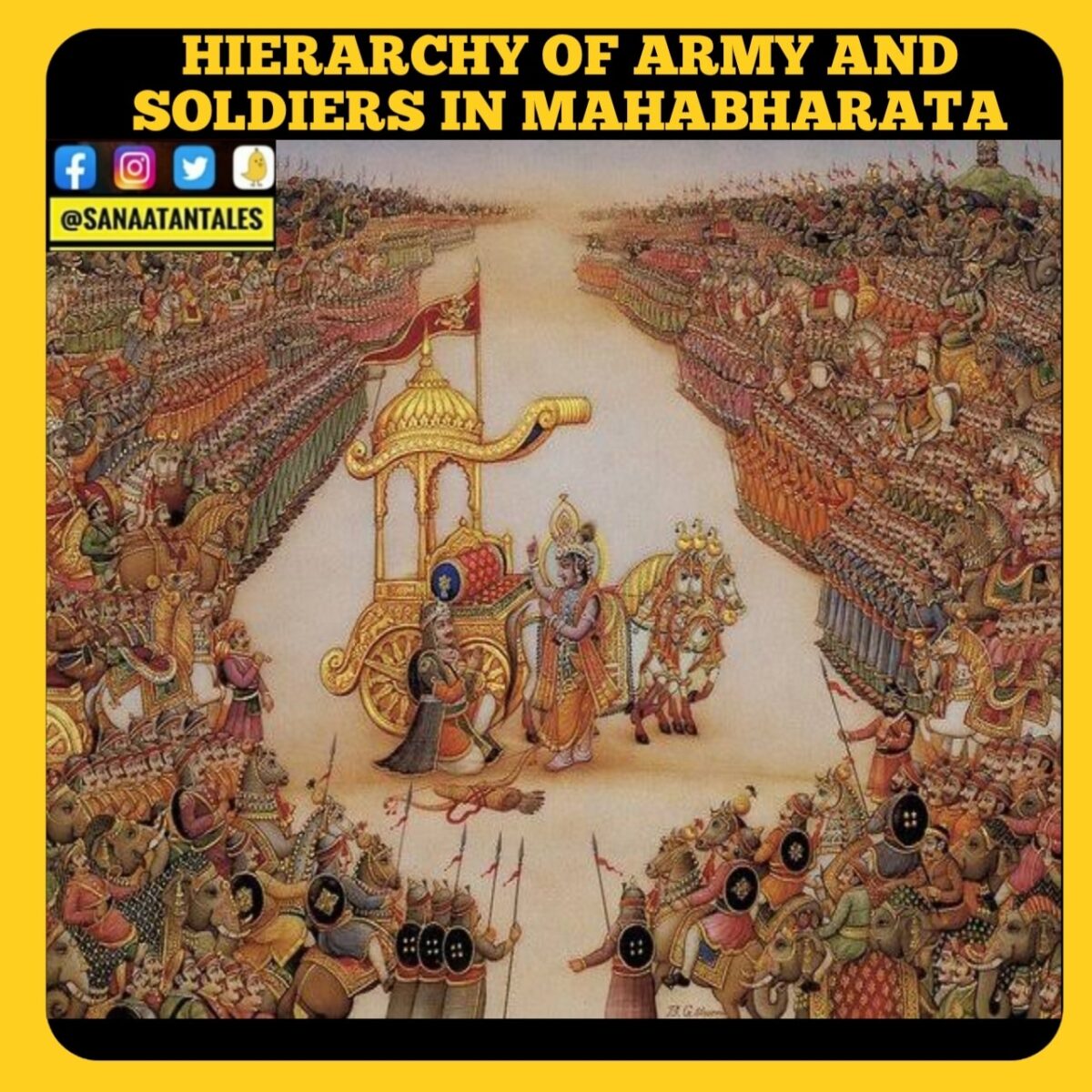
Hierarchy of Army and Soldiers in Mahabharata | iiQ8 Devotional
Let’s go step by step and break down the hierarchy of the army and soldiers in the Mahabharata in full detail. I’ll explain everything in a clear, structured, and easy-to-understand way.
- The Four Divisions of an Army (Akshauhini)
In the Mahabharata, an Akshauhini army was divided into four main divisions, representing the military forces on the battlefield:
- Elephants (Gaja) – The heavy armored war elephants, used to charge the enemy and break their ranks.
- Chariots (Ratha) – Fast, mobile units, often driven by skilled warriors and archers.
- Horses (Ashva) – Cavalry units for speed, mobility, and flanking enemy positions.
- Foot Soldiers (Padati or Infantry) – The backbone of the army, the largest in number, holding the front lines.
These divisions were combined in different proportions to form larger units.
- Hierarchy of Army Units
The Akshauhini army was organized in a nested structure, with each higher unit being 3 times larger than the previous, except the topmost level which is 10 times the previous.
Here’s the breakdown:
| Level | Unit Name | Elephants | Chariots | Horses | Foot Soldiers | Notes |
| 1 | Patti | 1 | 1 | 3 | 5 | Smallest basic unit |
| 2 | Senamukh | 3 | 3 | 9 | 15 | 3 × Patti |
| 3 | Gulam | 9 | 9 | 27 | 45 | 3 × Senamukh |
| 4 | Gana | 27 | 27 | 81 | 135 | 3 × Gulam |
| 5 | Vahini | 81 | 81 | 243 | 405 | 3 × Gana |
| 6 | Pritna | 243 | 243 | 729 | 1215 | 3 × Vahini |
| 7 | Chamu | 729 | 729 | 2187 | 3645 | 3 × Pritna |
| 8 | Anikini | 2187 | 2187 | 6561 | 10935 | 3 × Chamu |
| 9 | Akshauhini | 21870 | 21870 | 65610 | 109350 | 10 × Anikini |
Key points:
- Each unit is a building block of the next.
- Multiplication by 3 is consistent up to Anikini.
- The Akshauhini, the largest army, is 10 × Anikini, forming the full scale army used in major battles like Kurukshetra.
- Command Structure
Each unit had a commander who oversaw the soldiers. The titles indicate the strength and skill of the leader:
| Unit Level | Commander Title | Notes |
| Patti, Senamukh, Gulam, Gana | Ardharathi | “Half-chariot warriors” – lead small to medium units. |
| Vahini, Pritna, Chamu | Rathi | Skilled warriors capable of leading larger units. |
| Anikini | Atirathi | Elite warrior able to fight against multiple warriors simultaneously. |
| Akshauhini | Maharathi | Top commander of a full-scale army. |
| Special ranks beyond Maharathi | Ati-Maharathi = 12 Maharathis, Mahamaharathi = 24 Ati-Maharathis | Represent absolute mastery and near-superhuman battlefield capability. |
- Understanding the Soldier Distribution
- Soldiers in each unit type (elephant, chariot, horse, infantry) were divided equally under their unit commander.
- Example: In a Patti (smallest unit):
- 1 elephant → 1 commander
- 1 chariot → 1 commander
- 3 horses → 1 commander
- 5 foot soldiers → 1 commander
- As units grow larger, the number of sub-commanders also increases proportionally.
- The Big Picture
To give you an idea of the scale of the Akshauhini:
- 1 Akshauhini:
- 21,870 elephants
- 21,870 chariots
- 65,610 horses
- 1,09,350 infantry
- With such massive armies, each commander’s role was critical to maintain order.
- The hierarchy ensured smooth coordination from battlefield strategy (Maharathi) to small unit tactics (Ardharathi).
- Key Terms Simplified
- Patti = Smallest fighting unit
- Senamukh, Gulam, Gana = Medium units (building blocks)
- Vahini, Pritna, Chamu = Large units, elite leadership
- Anikini = Very large unit, led by Atirathi
- Akshauhini = Full-scale army, led by Maharathi
- Ardharathi < Rathi < Atirathi < Maharathi < Ati-Maharathi < Mahamaharathi → ranks of increasing power and skill
💡 Fun fact: The hierarchical system allowed strategic flexibility. Even in epic battles like Kurukshetra, armies could split into sub-units without losing command or coordination.